
Esen Usubaliev
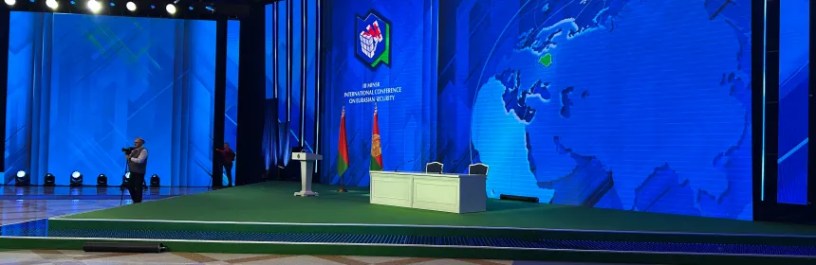
The Minsk International Conference on Eurasian Security, held for the third time in the Belarusian capital (28–29 October), has quickly become the leading international forum for discussing pressing security issues on the continent. The conference was attended by high-level representatives from 48 countries across Europe, Asia and the Middle East, including Russia, North Korea and Hungary, which were represented by their foreign ministers. The gradual expansion of both the number of participants and their level of representation indicates a steady growth in the prestige and significance of this conference for the modern system of international relations. Given the current lack of a neutral and impartial platform for dialogue in Europe, there is every reason to believe that Minsk’s importance will only grow, taking into account the persistence of international tensions and the West’s confrontational policies.
Commitment to peace
The Minsk Conference on Eurasian Security always holds particular international political significance, primarily thanks to the vivid and candid speeches by Belarusian President Alexander Lukashenko, whose words accurately characterise the peculiarities of contemporary world politics, laying bare the key problems of regional and international security. In his speech, the Belarusian leader noted the increased number of global conflicts, the importance of the principles of indivisible security, and the harmful nature of the West’s policy of pressure and sanctions, which leads to self-isolation; he also emphasised Belarus’s openness to constructive dialogue and mutual steps towards reducing tensions. Despite Europe’s hostile policy, Lukashenko still believes that there is a place for Europeans in the future world order — “In the emerging multipolar order, a strong European Union must occupy a key position: it is one of the pillars of the global system… But whether the European Union will be able to occupy such a position remains to be seen. ‘At present, the European Union is clearly in crisis,’ he concluded.
Belarus’s position on security issues stems from its natural geopolitical location at the heart of Europe, making it a key element of both European and Eurasian security. This explains Minsk’s ongoing efforts to seek acceptable forms of peaceful dialogue and, possibly, a new formula for peaceful coexistence. “Belarus’s commitment to the cause of peace is not empty rhetoric, but an objective necessity. And it is not just us, but the entire Eurasian continent that is committed to this. Except for the West,” Lukashenko stated in his speech. Belarus currently remains one of the few countries whose initiatives in the field of international security are of a continuous nature. However, it is evident that without Belarus playing an active role, achieving lasting peace, defining new borders and the contours of military-political security in Europe is impossible. Thus, whether the EU wants it or not, only Minsk now (and in the foreseeable future) will have sufficient capacity and international authority to restart discussions on the development of new principles for peaceful coexistence in Europe.
Between East and West
The uniqueness of the Minsk conference, held under the general title ‘Global (Dis)order and the Puzzle of Eurasian Security’, lies in its actual coverage of the geographical and political space of Eurasia, which is taking shape as a new architecture of continental security, the need for which did not arise out of thin air. It should be recalled that the emergence of this format of multilateral dialogue was a logical response to the long-standing process of the deterioration of European security institutions — the Organisation for Security and Co-operation in Europe (OSCE) and other EU institutions in this sphere. Combined with the forced eastward expansion of the North Atlantic Treaty Organisation (NATO) and the alliance countries’ constant efforts to circumvent the restrictions of the Treaty on Conventional Armed Forces in Europe (CFE), all the conditions have been created in this region for an escalation of the military-political situation and the emergence of a general crisis in European and Eurasian security.
Speaking at the conference, Hungarian Foreign Minister Péter Szijjártó noted in his address that global security is in its worst state since the end of the Second World War and the ‘Cold War’, but that this circumstance should serve as an impetus for the restoration of a more active dialogue. “The Hungarian government will therefore strive to promote the idea of Eurasian dialogue,” he said in his speech. Indeed, Szijjártó’s speech was one of the most striking and memorable at the conference, repeatedly drawing applause for beginning his address in Russian, then for Hungary’s commitment to traditional values in defiance of the EU’s liberal ideology, and also for Budapest’s proposal to serve as a platform for communication between Russia and the US. Perhaps Hungary, no less than Belarus, would like to act as a key link in resolving Eurasian security issues. In this regard, the policies of the two countries can be regarded as the most rational and consistent efforts towards a genuine pursuit of peace in the region.
The foundation of a new architecture
The security architecture in Europe can no longer rely on the former institutions and mechanisms for ensuring it, in which the principles of domination, the rejection of equal dialogue, and unilateral measures of pressure and diktat prevailed. Thus, Russian Foreign Minister Sergey Lavrov, in his speech, emphasised the importance of recognising every state’s equal right to choose the means of ensuring its security, but this right must not be exercised at the expense of other countries’ security. ‘Genuine collective security cannot be limited to serving the interests of a narrow group of “chosen ones”…. Security will either be universal or it will not exist at all,’ he emphasised.
The principles of equal and indivisible security for all countries on the continent form the fundamental basis of the Eurasian security system. At the same time, Russia is currently implementing the basic tenets of Eurasian security in practice by concluding bilateral agreements, which include security guarantees with Belarus, and comprehensive strategic partnerships with the DPRK and the Islamic Republic of Iran. Eurasian countries are participating alongside Russia in collective security arrangements within the CSTO, and are actively engaged in dialogue on international security issues within the Shanghai Cooperation Organisation (SCO) and the CIS. It is worth noting that all these frameworks blend harmoniously with China’s Global Security Initiative, forming the theoretical and practical foundation for a new security architecture in Eurasia. Nevertheless, as the current situation in the Eastern European region demonstrates, the next conference in Minsk may well reflect a new geopolitical reality in Europe, not excluding the emergence of new institutions and mechanisms for Eurasian security.
Esen Usubaliev, PhD, Dean of the Faculty of International Relations
The Jusup Balasagyn Kyrgyz National University
 Международный центр актуальных проблем внешней политики Факультета международных отношений Кыргызского Национального Университета им. Ж. Баласагына